About
Reading the ground
Search and rescue at fourteen, the Park Service at fifteen, and a route into criminology that ran through wildland fire and aviation safety before it reached a police department.
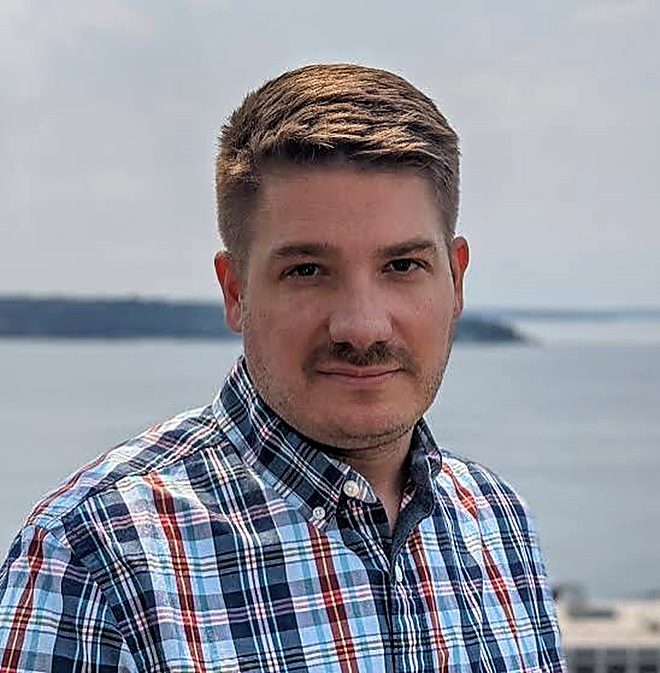
Seattle, Washington
Stevens County occupies the far northeastern corner of Washington, where the state runs on logging, mining and cattle and stops well short of anywhere. Loren Atherley grew up there, his father a geologist turned blacksmith and artist, his mother a cultural anthropologist and archaeologist for the US Forest Service. Between them they spent their careers standing on a piece of ground and reading it for evidence of what had happened there, one for what the rock had done and the other for what people had done, and left, and meant by it. Nobody in the house described it that way. It was simply the work going on around him.
At fourteen Loren joined Stevens County Search and Rescue as an Explorer Scout. His first callout came a few weeks later: an evidence search on a double homicide, a line of volunteers walking through timber looking for whatever the ground still held. He stayed with the unit until he was eighteen, through searches, rescues and recoveries. He dates his interest in criminal behavior to that first search.
Public service came early and stayed. The National Park Service took him on as a volunteer at eleven and hired him as one of the youngest Park Rangers in the system at fifteen. He worked seasons at Lake Roosevelt National Recreation Area until he was twenty-two, doing visitor education, marine patrol and wildland fire. Fire meant initial attack, evacuations, and the long unheroic hours that make up most of that job.
Later he spent a year with King County Sheriff's Office Special Operations on search and rescue, one of the largest such organizations anywhere, with roughly eight hundred volunteers and hundreds of operations a year. He also interned with the Social Security Administration's Office of Inspector General in Seattle, investigating fraud, which he liked more than he expected to. By his early twenties he had worked for a federal land agency, a county sheriff and a federal inspector general, and had made a close study of how each one functioned.
None of it was designed. It was a rural adolescence in a place where competent adults were scarce enough that real jobs went to whoever turned up and could be relied on. What it produced, incidentally, was an unusual amount of early exposure to the moment after something has already gone wrong. The fire is burning. The person is missing. The decisions have been made and the consequences are lying there, and the work is to reconstruct what happened from what remains.
The formal study came afterward, and it followed the same interest. At Seattle University he studied political science with a focus on global security, then stayed for a master's in criminal justice on the investigative criminology track. His thesis went after criminal profiling, testing the method against the Green River Killer investigation to see what it had actually delivered across two decades of a real case. He describes the question he was asking as whether a well-regarded technique does what its practitioners say it does. It is a question he has gone on asking.
Applying any of it began, unpromisingly, with two years managing safety for a fixed base operator at Boeing Field. He had learned to fly at fifteen and held a license by seventeen, an interest that ran parallel to everything else and would connect to it in unexpected ways. After graduate school the work offered a much needed break from the study of crime, and he took it without any expectation that it would matter later.
That interval is easy to skip and probably shouldn't be. Aviation safety is the study of failure and of risk, and much of it is minimax reasoning: designing against the worst available outcome rather than the likeliest one, on the grounds that in flight the worst outcome cannot be recovered from. Practitioners find the failure that has not happened yet by studying the near misses that already have. The discipline borrowed heavily from nuclear power and chemical process manufacturing, both of which had concluded well before aviation did that individual blame explains little and system design explains most. That is roughly the argument policing has been having ever since, and those lessons would go on to inform Loren's own work on risk management in police operations.
Loren found himself in the middle of that argument in 2013. The Seattle Police Department hired him the year after its consent decree, and he has worked on the decree ever since. Few people can say that. The work is long and the turnover is high.
His role was what the field calls pracademic: a practitioner working to research standards inside an agency rather than studying one from outside. The court wanted proof of compliance. Proof meant analysis of a quality most departments cannot produce. Loren built the capability that produced it, then ran it. Performance analytics and research is how an agency shows a federal court what it is actually doing rather than what it believes it is doing. He has advised the Chief of Police and the Mayor. In 2020 the National Institute of Justice named him a LEADS Scholar. In 2022 George Mason University inducted him into its Evidence-Based Policing Hall of Fame.
The doctorate came in the middle of the work rather than before it, which was the point. Going straight from a master's to a PhD would have put him in front of students with nothing practical to tell them. So he went to work first and took the degree afterward, with a decade of the actual job behind him. That is the pracademic route, and he chose it. He had also been given a piece of advice he chose to take literally: find the best doctoral program you can and pursue it relentlessly. He did it at the Institute of Criminology at Cambridge, under Professor Lawrence W. Sherman, the father of evidence-based policing. The dissertation concerns risk management in police response, and what ought to happen when the call that comes in turns out not to be a police problem.
What all of it has produced is a working knowledge of criminology and the business of policing, which covers most of what people currently worry about. Criminal behavior and police behavior. Police reform, and what it does and does not deliver. Risk management. How a department actually runs, what it measures, what it can prove, and how policing works, or fails to work, as a way of producing public safety. The knowledge is operational as well as academic. Lawyers on both sides of police litigation tend to read a department's records as plain measurements of events. They are not. They are artifacts of an organization under pressure, and reading them properly means knowing the organization that produced them.
Loren is a pracademic criminologist. As an internal consultant to the City of Seattle, he advises on criminology, criminal justice and police reform. Independently, he practices as a forensic criminologist, retained by government agencies and by attorneys in matters that turn on police conduct. At Seattle University he is an adjunct professor of criminal justice and teaches a course on serial murder.